
i speak more than three languages and belong fully to none
on polyglot personalities, strange colonial guilt, and the freedom of living within the nuances of languages


A Childhood Spent Packing and Unpacking
I am half-Malayali, half-Tamilian. I was raised across South India during my childhood, thanks to Appa’s* telecom job which entailed transfers every two to three years.
*(Appa means father in Tamil)
New city, new school, new classrooms I walked in as the new kid. The outsider. The non-localite kid.
What this childhood gave me was different languages. Different cultures to soak up. Perhaps this is the reason why travel makes me feel free in a way that no other experience does.
At home, we switched fluidly between Malayalam, Tamil, and English. Sometimes it’s mid-sentence, sometimes it’s mid-word which is unique to multi-lingual families who do it effortlessly without batting an eyelid.
School and Bollywood brought Hindi because it was the common language amidst transfers. Slowly but surely, I grew up learning to love a new language. Bangalore and early university years brought Kannada.
Extra time on my hands during COVID lockdown was fabulous because I used it to learn French, having dreamt of Switzerland, seduced by the idea that French could open a plethora of business doors across continents.
Then came Dutch when I moved to Rotterdam. A Duolingo streak set up the basic foundation which pushed me to embarass myself by practising the initially-broken-expat-Dutch at the weekly farmers’ markets and local cafes.
So over the years, I picked up three extra languages. A polyglot by circumstance, curiosity, and sometimes necessity.
The Language I Live In
Here’s an honest truth: I think in English.
Not Malayalam. Not Tamil. Not Hindi. Not Dutch. My thoughts pop up in English first, which is the language my vocabulary is strongest in, where I feel most entirely, most reflexively like myself.
I watch Indian films with English subtitles because my comprehension is most in-depth in English. Weirdly, the emotions also land in a cleaner manner.
It sounds strange. I know!
What’s even more strange is this - When reciting a prayer in Tamil or Malayalam, something makes me feel at peace. When I sing an Adele song, I feel that similar peace.
Home - as it turns out - is less about the language and more about the feeling.
In my case, that feeling of home and belongingness is spread across a myriad of cultures, languages and now, across countries. It isn’t exclusive to one.
The Strange Colonial Ghost in the Room
There’s a linguistic hypocrisy I’ve been pondering for years now, which I also think is worth claiming.
In India, speaking English fluently with a borrowed accent that does not have a tint of your native tongue is considered supreme, elite, classy, and desirable. But through my interactions with Non-Native English speakers, a French person having the French accent or an Italian speaking passionately in a heavy Italian accent is considered “cute”, “charming” and sometimes even “attractive”?
What is this hypocrisy? Where does it stem from? Why do we reserve pride for a language that was borrowed and feel embarrassed for our own?
I speak for myself when I say: I am 100% sure that there is something colonial in that flex. Something inherited, that isn’t naturally mine. The instinct to excel and have great command in English as the language of skill, intelligence, and to be taken seriously came through implicit quiet teachings that’s been flowing within generations.
And simultaneously, I find my entire self-expression in English!!! Take this newsletter for instance.
It isn’t performance. It is a fact. This is who I am. There’s something both limiting and freeing about it. On one hand, my vocabulary is impeccable in English. But at the same time, I struggle to recall what fenugreek seeds is called in Malayalam (it’s Uluva - which I recollect after a few seconds).
Which makes this thing an even more complicated affair - The awareness that a part of your authenticity was partly shaped by eons of history that existed before you did.
A Different Personality in Every Language
What I’ve noticed is that, I also don’t sound like the same person in every language. I am not the same person in every language.
When I speak Malayalam, I sound more rugged. When I speak Tamil, I sound more polite, as though I am more intentional with my words. When I speak English, I sound like me. When I speak Dutch, I sound harsh with my throat-garling phonetics that come with the language.
A famous meme my sister refers to all the time comes to mind now.
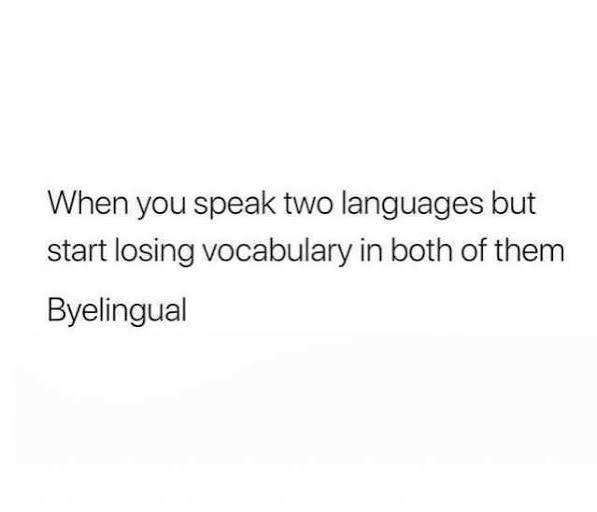
(source: pinterest)
As funny as this is, it’s also the truth for those who grow up in a multi-lingual household. Expressing yourself in one specific language becomes stronger over another.
It’s almost as if a different brain is linked to every language we speak with different emotional layers and textures to it. If you grew up in this context, you know exactly what I mean by this!
Three Years Away Changed Something In Me
Living in the Netherlands for three years tore layers of something in which I didn’t anticipate.
Watching people from all over the world - Dutch, Egyptians, Germans, Indonesians, French etc - speak their native language without the usage of even one word of English in their conversation combined with the pride they have about their accent when speaking English, genuinely humbled me.
During my first year in Rotterdam, I’d shrug off celebrating Indian festivals without a second thought thinking that was more cool. In fact, I rarely cooked Indian food during the initial months. By my second year, thanks to one of my best friends, I was cooking Indian food more often, I ordered Diyas to celebrate Diwali and even celebrated it with my friends (who were all internationals).
With time, something changed. The further I was away from home, I more I longed to carry it with me.
Making Peace With This Fluidity
There is no clean slated forward with this. I genuinely don’t think I could speak Malayalam or Tamil without the occasional English word slipping in.
I also don’t think English will ever stop being the language that naturally comes to me first (depending on the context).
But I’ve also realized that, with upcoming generations, including people like me being out of touch with their roots mandates the need to go to back to our roots even more.
That’s why I’ve actively been trying to remember the names of basic things that exist in my environment to the best of my ability. I ask both Amma and Appa when I stumble recollecting the word for something specific.
At the same time, I am also holding it as it is without the need of having to explain it something neat and tidy.
I think in English. I feel in Malayalam. I resonate in Tamil. I dance like there’s no tomorrow in Hindi. In between the Dutch practise on Duolingo and my daily prayer recitals, this is where I live.
This is where I am home.
This is who I am.
See you next Sunday! With another draft :)
Very well written Sammy girl... I can resonate with you ☺️